AEROSPACE ENGINEERING
UNDERGRADUATE PROGRAM
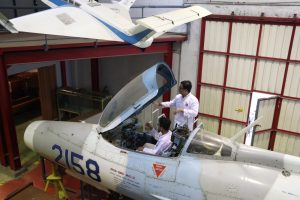
Lecturers, students, and alumni of ITB’s Aerospace Engineering program have consistently been actively involved at every stage of the development of Indonesia’s strategic aerospace technologies.

Dr. Annisa Jusuf, S.T, M.T.
Head of Undergraduate and Graduate
Programs in Aerospace in Engineering
The main focus of the Undergraduate Aerospace Engineering Program includes structures, aerodynamics, flight mechanics, aircraft and spacecraft systems, and transportation systems. Graduates will posses a strong and comprehensive understanding of fundamental engineering sciences and their application to Aerospace Engineering.
The Undergraduate Aerospace Engineering Program uses a semester credit system (SKS), in which students are required to complete 144 credits designed to be accomplished within a four-year study period.
First Year
In the first semester, students of FTMD ITB take courses collectively at the faculty level in a stage known as the First-Year Common Curriculum (Tahap Persiapan Bersama or TPB). After completing TPB, students will choose their intended major from one of the three study programs: Tenik Mesin FTMD ITB, Teknik Dirgantara FTMD ITB, or Teknik Material FTMD ITB. The faculty evaluation team will then assign students to the program that best aligns with their interests and abilities.
In the first year, FTMD students—similar to those in other faculties—complete a total of 36 credits consisting of basic science courses such as Mathematics, Physics, Chemistry, and Introduction to Engineering and Design. In addition, students take three faculty introductory courses—Introduction to Mechanical Engineering, Aerospace Engineering, and Materials Engineering—as well as Engineering Drawing and Structural Statics.
Second and Third Year
In the second and third years, students enrolled in the Undergraduate Aerospace Engineering at FTMD ITB take fundamental engineering science courses as well as advanced subjects specifid to the field of aerospace engineerin. In general, students complete approximately 36 credits per year, or 18 credits per semester. At this stage, students may take more than 18 credits per semester if they meet certain requirements; therefore, consultation and approval from their academic advisor are essential.
Courses at this level include topics such as Fundamental of Aircraft Materials and Structures, Aerodynamics, Astrodynamics, Flight Performance and Dynamics, Aircraft Systems, and Air Transportation Systems. Some of the material is delivered through laboratory practice, such as Instrumentation, Measurement, and Experimentation. Additionally, students participate in group project assignments, such as the Aircraft Design course and the Analysis and Design of Lightweight Structures course.
Fourth Year
In the final stage of the program, students undertake an industrial internship as a means of applying the knowledge and skills acquired throughout their studies. Afterwards, they complete their final project (tugas akhir) in accordance with their chosen area of specialization.
In addition, students may take elective courses offered both within the Aerospace Engineering Program and outside the department. The program provides more than ten elective courses that students may choose to strengthen their competencies and support the completion of their final project.
At the end of their studies, students must pass a comprehensive examination and successfully defend their final thesis as part of the graduation requirements for the undergraduate program.
Curriculum Structure
| Semester 1 | ||
|---|---|---|
| Code | Course Name | Credit |
| MA1101 | Mathematics I | 4 |
| FI1101 | General Physics I | 3 |
| WI1111 | Basic Physics Laboratory | 1 |
| WF1100 | Introduction to Mechanical, Material and Aerospace Engineering | 1 |
| KI1101 | General Chemistry I | 3 |
| WI1101 | Pancasila | 2 |
| WI1102 | Computational Thinking | 2 |
| WI1103 | Introduction to Principles of Sustainability | 2 |
| WI1112 | Basic Chemistry Laboratory | 1 |
| Semester 2 | ||
|---|---|---|
| Code | Course Name | Credit |
| WF1200 | Engineering Drawing | 2 |
| WF1202 | Statics | 2 |
| WI2001 | Introduction to Engineering and Design | 3 |
| MA1203 | Mathematics IIC (for Engineering I – Mechanical and Aeronautics Engineering) | 4 |
| WI2005 | Indonesian Language | 2 |
| WI2003 | Sports | 1 |
| FI1201 | General Physics IIA | 3 |
| Semester 3 | ||
|---|---|---|
| Code | Course Name | Credit |
| WF2102 | Linear Algebra and Differential Equations | 3 |
| WF2101 | Mechanics of Materials | 3 |
| AE2100 | Introduction to Aerospace Engineering | 2 |
| AE2102 | Thermal Engineering | 4 |
| AE2104 | Kinematics and Dynamics | 4 |
| WI2004 | English | 2 |
| Semester 4 | ||
|---|---|---|
| Code | Course Name | Credit |
| WF2202 | Partial Differential Equations and Numerical Methods | 3 |
| AE2202 | Fluid Mechanics | 4 |
| AE2203 | Aerospace Materials and Manufacturing Methods | 4 |
| AE2204 | Dynamic System | 3 |
| WI2002 | Artificial Intelligence and Data Literacy | 2 |
| BI1012 | Biology B | 2 |
| Semester 5 | ||
|---|---|---|
| Code | Course Name | Credit |
| AE3100 | Instrumentations, Measurements, and Experiments | 3 |
| WF3102 | Statistics | 2 |
| AE3102 | Aerodynamics | 4 |
| AE3103 | Lightweight Structure Analysis and Design | 4 |
| AE3104 | Mechanical Vibration | 3 |
| AE3105 | Control Engineering | 3 |
| Semester 6 | ||
|---|---|---|
| Code | Course Name | Credit |
| AE3200 | Aircraft Performance for Design | 3 |
| AE3202 | Aircraft Propulsion | 4 |
| AE3204 | Flight Dynamics | 3 |
| Semester 7 | ||
|---|---|---|
| Code | Course Name | Credit |
| AE4000 | Aerospace Vehicle Design | 4 |
| AE4098 | Undergraduate Thesis 1 | 2 |
| WI2006 | Civic Education | 2 |
| WI201X | Religion | 2 |
| Semester 8 | ||
|---|---|---|
| Code | Course Name | Credit |
| AE4099 | Undergraduate Thesis 2 | 3 |
| AE4091 | Profession and Community Development A | 1 |
| WI2021 | Industrial Engineering Management | 2 |
| Elective Course | ||
|---|---|---|
| Code | Course Name | Credit |
| AE4002 | Airworthiness Certification | 3 |
| AE4010 | Introduction to Computational Fluid Dynamics | 3 |
| AE4011 | Experimental Fluid Dynamics | 3 |
| AE4012 | High Speed Aerodynamics | 3 |
| AE4013 | Rotor Aerodynamics | 3 |
| AE4020 | Finite Element Methods | 3 |
| AE4021 | Aircraft Loads | 3 |
| AE4022 | Impact Mechanics | 3 |
| AE4030 | Flight Vehicles Modelling and Simulation | 3 |
| AE4031 | Unmanned Aerial Vehicle (UAV) Operations | 2 |
| AE4032 | Spacecraft Operations | 2 |
| AE4033 | Flight Communication, Navigation and Surveillance | 2 |
| AE4034 | Astrodynamics | 3 |
| AE4041 | Aviation System Planning | 4 |
| AE4050 | Air Transport Modelling and Simulation | 3 |
| AE4051 | Air Transportation | 3 |
| AE4052 | Aircraft System | 3 |
| AE4053 | Aircraft Maintenance Engineering | 3 |
| AE4054 | Airport System | 2 |
| AE4081 | Specific Case in Aerospace System Engineering A | 2 |
| AE4082 | Specific Case in Aerospace System Engineering B | 3 |
| AE4083 | Specific Case in Aviation A | 2 |
| AE4084 | Specific Case in Aviation B | 3 |
| AE4091 | Profession and Community Development A | 1 |
| AE4092 | Profession and Community Development B | 2 |
| AE4093 | Profession and Community Development C | 3 |
| AE40X0 | Aerospace Computational Methods | 3 |
Specialization
The Aerospace Systems Engineering concentration package offers an in-depth understanding of the research, technology, design, and development of systems in the aerospace industry. This package comprises three priority courses and elective courses from the three sub-disciplines of Aerospace Engineering: Aerodynamics, Lightweight Structures, and Flight Mechanics. Students are required to take the three priority courses: Professional Ethics, Airworthiness Certification, and Computational Methods, combined with one elective course from the subdiscipline, totaling a minimum of 16 credits. Students that are planning to take on the fasttrack program to Master degree are required to take the Minor Research course.
| Compulsory Subject | ||
|---|---|---|
| Code | Course Name | Credit |
| AE4001 | Engineering Professional Ethics | 2 |
| AE4002 | Airworthiness Certification | 3 |
| AE40X0 | Aerospace Computational Methods | 3 |
| Elective Course | ||
|---|---|---|
| Code | Course Name | Credit |
| AE5086 | Minor Research | 4 |
| AE4010 | Introduction to Computational Fluid Dynamics | 3 |
| AE4011 | Experimental Fluid Dynamics | 3 |
| AE4012 | High Speed Aerodynamics | 3 |
| AE4013 | Rotor Aerodynamics | 3 |
| AE5011 | Viscous Flow | 4 |
| AE5012 | Turbulent Flows | 4 |
| AE4020 | Finite Element Methods | 3 |
| AE4021 | Aircraft Loads | 3 |
| AE4022 | Impact Mechanics | 3 |
| AE5021 | Continuum Mechanics I | 4 |
| AE4030 | Flight Vehicles Modelling and Simulation | 3 |
| AE4031 | Unmanned Aerial Vehicle (UAV) Operations | 2 |
| AE4032 | Spacecraft Operations | 2 |
| AE4033 | Flight Communication, Navigation and Surveillance | 2 |
| AE4034 | Astrodynamics | 3 |
| AE4052 | Aircraft System | 3 |
| AE5030 | Aircraft Trajectory and Parameter Estimation | 3 |
| AE5031 | Advanced Flight Dynamics | 3 |
| AE5032 | Flight Control | 3 |
| AE5035 | Advanced Control Engineering | 3 |
| AE4081 | Specific Case in Aerospace System Engineering A | 2 |
| AE4082 | Specific Case in Aerospace System Engineering B | 3 |
| MS4096 | Industrial Internship | 6 |
| MS4097 | Minor Research | 3 |
| MS4061 | Materials and Information Flows Analysis | 3 |
| MS4062 | Industrial Manufacturing Process | 3 |
The Aviation concentration package offers a comprehensive understanding of flight operations and management in the aerospace industry. Students can explore topics such as Air Transportation, Fight Safety, Airport Management, and Aviation Business. In this package, students will also have the opportunity to be guided in planning an aviation system. Within this concentration, students are required to take three core courses: Professional Ethics, Airworthiness Certification, Air Transportation Modeling and Simulation, and Aircraft Systems, along with elective courses to fulfill a minimum of 16 credits.
| Compulsory Subject | ||
|---|---|---|
| Code | Course Name | Credit |
| AE4001 | Engineering Professional Ethics | 2 |
| AE4002 | Airworthiness Certification | 3 |
| AE4050 | Air Transport Modelling and Simulation | 3 |
| AE4051 | Air Transportation | 3 |
| AE4052 | Aircraft System | 3 |
| Elective Course | ||
|---|---|---|
| Code | Course Name | Credit |
| AE4053 | Aircraft Maintenance Engineering | 3 |
| AE4030 | Flight Vehicles Modelling and Simulation | 3 |
| AE5056 | Aviation System Planning | 4 |
| AE4033 | Flight Communication, Navigation and Surveillance | 2 |
| AE4054 | Airport System | 2 |
| AE5053 | Flight Operations | 3 |
| AE5057 | Aviation Business | 3 |
| AE5055 | Aircraft Accident Investigation Analysis | 3 |
| AE4083 | Specific Case in Aviation A | 2 |
| AE4084 | Specific Case in Aviation B | 3 |