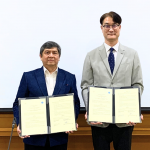
ITB Doctoral Student in Materials Engineering Conducts Research at NTU, Discovering New Knowledge and Cultures
A doctoral student in the Materials Engineering Study Program, Faculty of Mechanical and Aerospace Engineering (FTMD), Institut Teknologi Bandung (ITB), Moch Saifur Rijal, had the opportunity to participate in a Postgraduate Research Exchange program at Nanyang Technological University (NTU), Singapore. This program is part of a research collaboration between Indonesia and the NTU Singapore Institute of Research for Sustainability and Innovation (INSPIRASI). He carried out two research periods at the School of Materials Science and Engineering (MSE), NTU, from 3 September–27 November 2024 and 14 January–15 May 2025.
Rijal is currently developing research entitled “Valorising Sericin- and Keratin Protein-Based Biomass Residues for Hydrogel Biomaterials.” Under the supervision of Dr. Arie Wibowo and Dr. Lia Amelia Tresna Wulan Asri, the young researcher seeks to utilize protein-based biomass waste—such as human hair, chicken feathers, wool, and silkworm cocoons—to produce environmentally friendly and biocompatible hydrogel biomaterials for wound healing. “The high biocompatibility of keratin and sericin proteins has great potential to accelerate wound healing. Through this research, waste can be transformed into high-value materials for biomedical applications,” he explained.
The laboratory background at FTMD ITB where he is based indeed focuses on the concept of sustainability. Rijal acknowledged that this sustainable approach is what has increasingly drawn his interest toward processing biomass waste into advanced materials. Previously, during his master’s studies, he also researched cellulose-based biomaterials for seawater desalination membranes. “We want to prove that green innovation can emerge from laboratories in Indonesia,” he said.
However, his experience at NTU offered new perspectives beyond the laboratory. He shared that he gained many valuable lessons from daily life in Singapore, ranging from the efficiency of public transportation to social governance that values punctuality and cleanliness. “Exposure to a developed country opened my eyes to the fact that quality of life and strong social systems also play a major role in supporting research productivity,” he noted.
In addition, the research culture at NTU left a deep impression on Rijal. He observed how every dataset is tested repeatedly to ensure validity and how communication among researchers is maintained professionally. “An ethical and disciplined research culture makes every step measurable. In Indonesia, limited facilities can sometimes be an obstacle, but at NTU everything is highly systematic,” he said.
During his time at NTU, Rijal had the opportunity to use advanced research facilities, including biocompatibility testing laboratories that require high biosafety standards. He also gained access to subscribed scientific journals and a personal workspace that supported academic productivity. From this collaborative research, he is currently preparing a draft book chapter together with the NTU team.
For Rijal, being an ITB student provides a significant advantage in the form of a strong research network, both domestically and internationally. “ITB’s network is very strong. It’s a privilege that I am grateful for because it opens up collaboration opportunities and broadens my research perspective,” he expressed.
More than just research, this international experience enriched his outlook on the meaning of global collaboration and cross-cultural life. He hopes to bring these insights back to Indonesia to help strengthen a more open, ethical, and high-standard research culture. “Knowledge does not only come from the laboratory, but also from how we learn to appreciate systems and people in other places,” he reflected.
Through experiences such as those undertaken by Moch Saifur Rijal, FTMD ITB demonstrates that the internationalization of doctoral programs is not only about facilities and publications, but also about shaping researchers with global perspectives, strong ethics, and adaptability to a changing world.