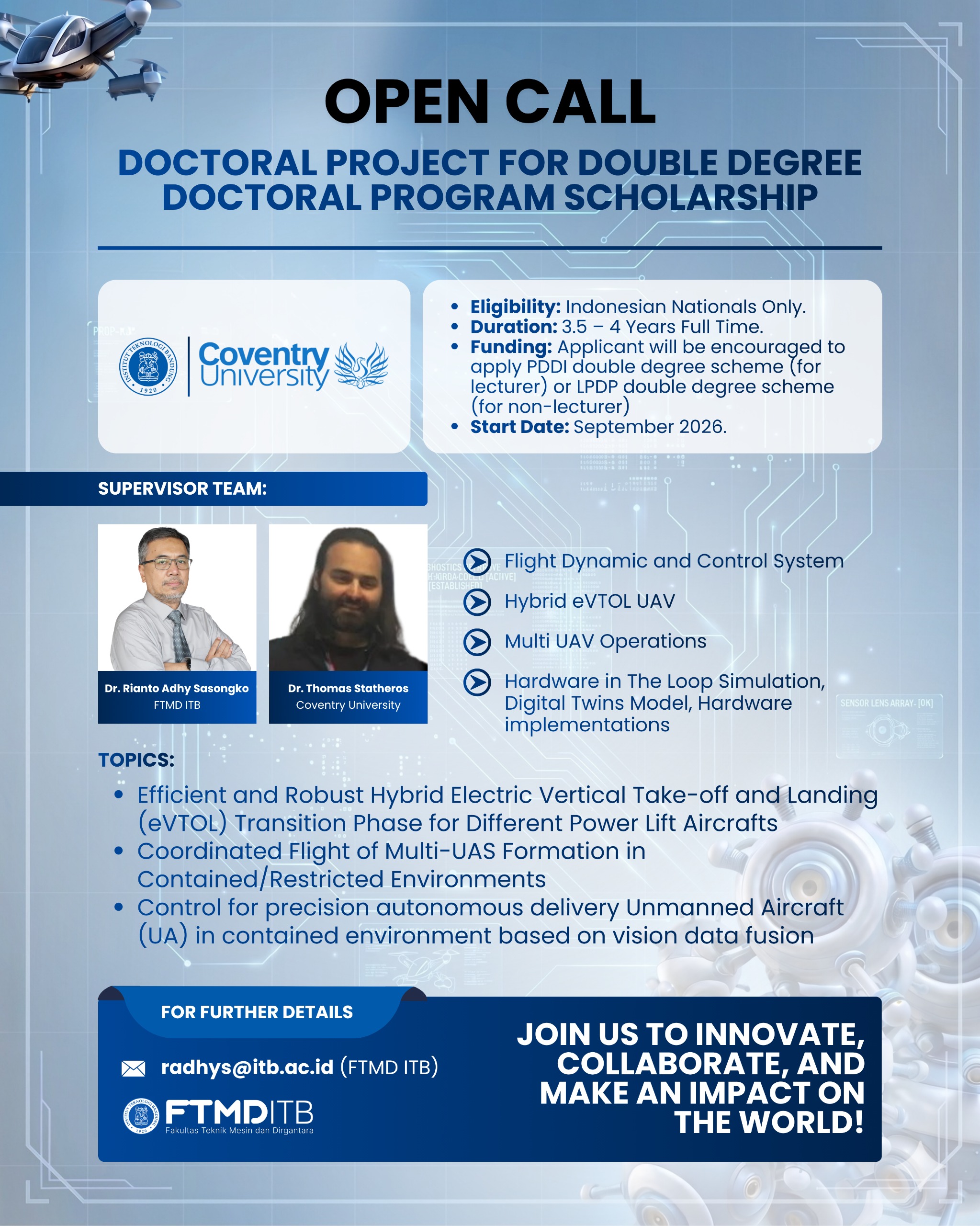
Efficient and Robust Hybrid Electric Vertical Take-off and Landing (eVTOL) Transition Phase for Different Power Lift Aircrafts
Project title: Efficient and Robust Hybrid Electric Vertical Take-off and Landing (eVTOL) Transition Phase for Different Power Lift Aircrafts
Eligibility: Indonesian nationals
Duration: Full-Time – between three and four years fixed term
Application deadline:
Interview date: Will be confirmed to shortlisted candidates
Start date: September 2026
For further details contact: Dr. Rianto Adhy Sasongko, S.T., M.Sc., Ph.D. (ITB, radhys@itb.ac.id), Dr. Thomas Statheros (CU, thomas.statheros@coventry.ac.uk)
Introduction
Efficient and robust transition performance is a critical challenge in electric Vertical Take-off and Landing (eVTOL) aircraft design, particularly for power-lift configurations that rely on distributed propulsion systems. This project focuses on analysing the transition phase between hover and forward flight, widely recognised as the most complex and safety-critical segment of operation. It will investigate transition profiles for both hover-to-cruise and cruise-to-hover conditions, considering the unique aerodynamic and propulsion characteristics of different aircraft types (e.g. tilt rotor and independent thrust). The study also aims to identify suitable control strategies to enhance stability, efficiency, and overall robustness during these critical phases of flight.
Project details
The student will work on the vehicle dynamics of at least two different eVTOL configurations, with one of them to be a tilt-rotor configuration. Different trajectory profiles of the transition phase will be investigated to support appropriate real-time control methodologies. The main project investigation is to identify the best trajectory profile reference and control methodology to support the safe and robust transition phase of two types of eVTOL.
In the first phase of the project, a literature review, will take place related to research gap analysis on the eVTOL real-time transition phase for at least two different eVTOL configurations, as well as the related control methodologies. The second phase of the project will investigate the static and dynamic analysis of the transition phases. Based on this, appropriate aircraft profiles will be determined for the transition phases. Finally, different real-time control methodologies will be explored and coupled with the transition profiles for both hover-to-cruise and cruise-to-hover aircraft conditions.
The system real-time validation will take place based on simulation and hardware in the loop, utilising NVIDIA Orin AGX technology. The eVTOL dynamic model will be implemented in Matlab, Gazebo or X-Plane, the student will have access to an high-end computer with NVIDIA RTX 6000 Ada for simulation.
Objectives:
- To model and analyze the dynamics characteristics of hybrid eVTOL
- Investigate efficient and safe profiles related to the aircraft flight envelope during the transition phase of the eVTOL.
- To elaborate and evaluate the control algorithm that can anticipate the dynamics of the hybrid eVTOL and provide precise maneuver control, especially in transition phases.
- Design and configure the eVTOL digital twins model and the hardware-in-the-the-loop simulation platform
- Implement and compare the performance of different real-time control algorithms for at least two eVTOL configurations, e.g. including tilt rotor and independent thrust.
- Investigate the advantages and disadvantages of each configuration related to real-time requirements, safety, energy efficiency, and minimum transition phase velocity and distance.
Funding
Tuition fees and bursary from LPDP or PDDI
Benefits
The successful candidate will receive comprehensive research training including technical, personal, and professional skills. All researchers at Coventry University (from PhD to Professor) are part of the Doctoral and Researcher College, which provides support with high-quality training and career development activities.
Entry requirements
- A minimum of a 2:1 first degree in a relevant discipline/subject area with a minimum 60% mark in the project element or equivalent with a minimum 60% overall module average.
PLUS
- The potential to engage in innovative research and to complete the PhD within 3.5 years.
- A minimum of English language proficiency (IELTS academic overall minimum score of 6.5 with a minimum of 6.0 in each component).
Additional Requirements
- Applicants should have a Master’s degree in a relevant field is desirable, including but not limited to:
- Aerospace Engineering (vehicle dynamics)
- Control Engineering
- Electrical Engineering
- Mechanical Engineering
- Computer Science
- Applicants should have good knowledge and skill in :
- Mathematics/Quantitative analysis (e.g., dynamic modelling, control theory, flight dynamics, numerical simulation)
- Programming skill (C++, Matlab, Phyton, etc)
- Hardware-in-the-loop NVIDIA Processors (e.g., NVIDIA Orin, Pixhawk)
- Academic/technical writing skills
- The ideal candidate will be motivated, aerospace engineering inclined, interested in eVTOL aircraft technology, control, programming, and vehicle dynamics.