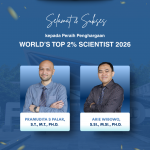
Two FTMD ITB Lecturers Named in the World’s Top 2% Scientists 2026 List
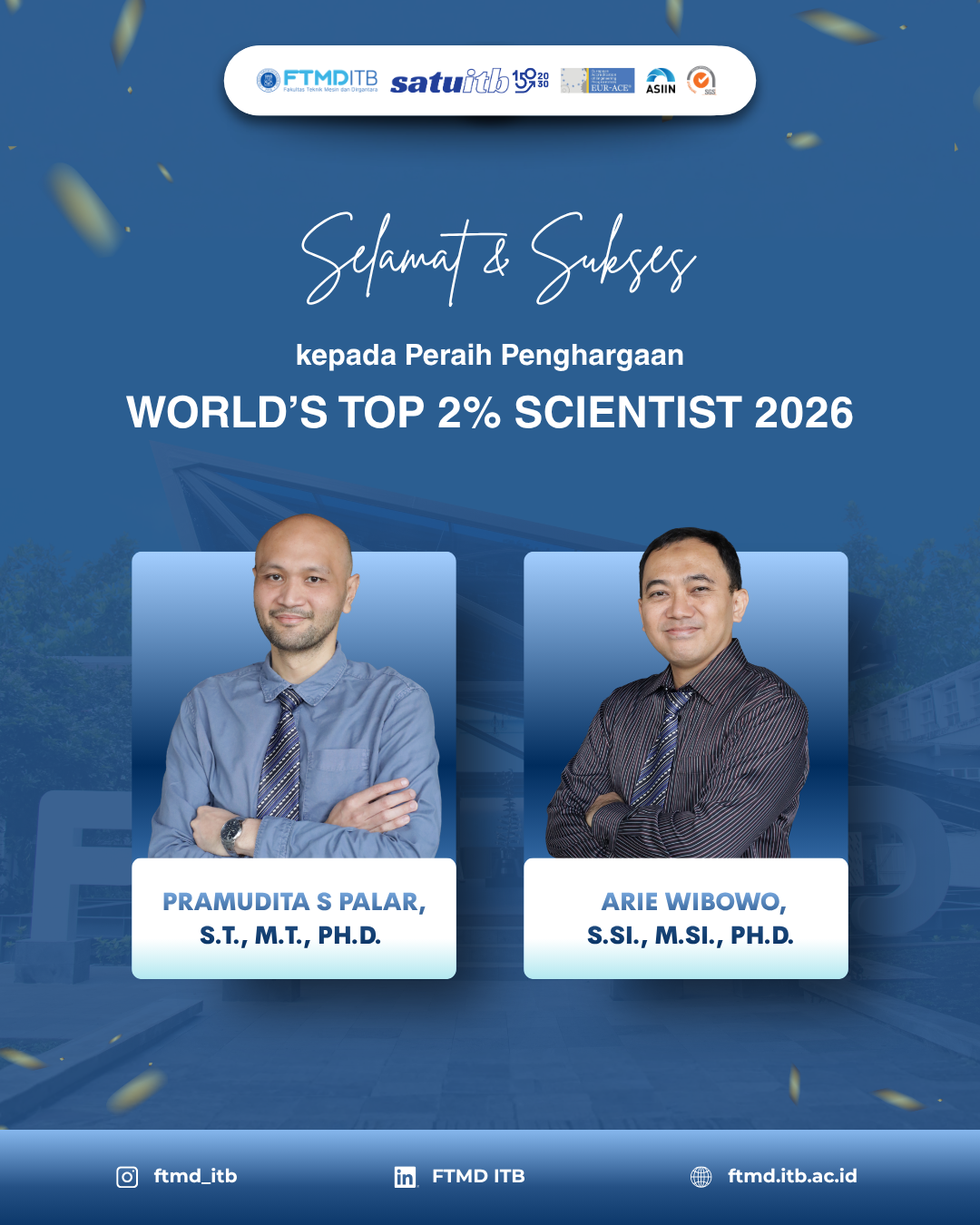
BANDUNG, ftmd.itb.ac.id – Two faculty lecturers of the Faculty of Mechanical and Aerospace Engineering (FTMD) Institut Teknologi Bandung (ITB), Ir. Pramudita Satria Palar, S.T., M.T., Ph.D., and Arie Wibowo, S.Si., M.Si., Ph.D., have been listed in the World’s Top 2% Scientists 2026 rankings, published on October 7, 2026. Out of the 15 ITB scientists featured on the list, two hail from FTMD ITB. For Pramudita Satria Palar, this achievement marks his third consecutive inclusion, having previously appeared in the rankings in 2024 and 2025.
The World’s Top 2% Scientists list is compiled based on bibliometric indicators derived from Scopus data. The 2026 edition utilizes Scopus profile data as of August 1, 2026, incorporating career-long impact indicators through the end of 2025 alongside annual impact indicators based on citations received throughout 2025. The evaluation encompasses several metrics, including total citations, the h-index, and the composite c-score indicator, to reflect the scholarly impact of researchers’ scientific works.
Pramudita Satria Palar: Advancing Engineering Optimization and Machine Learning
Ir. Pramudita Satria Palar, S.T., M.T., Ph.D., is an FTMD ITB faculty member from the Fluid Dynamics and Propulsion Research Group. He completed his bachelor’s and master’s degrees at ITB in 2010 and 2012, respectively, and subsequently earned his doctoral degree from The University of Tokyo, Japan, in 2015.
Pramudita’s research focuses on engineering design optimization, computational modeling, uncertainty analysis, and the application of machine learning to various engineering challenges. These fields serve as the foundation for developing computational methods that enhance the efficiency of design, simulation, and analysis processes in engineering systems.
For the 2025–2026 period, the compiled research records indicate 15 projects led or developed by Pramudita, comprising eight projects in 2026 and seven in 2025. Broadly speaking, these projects encompass topology optimization, scientific machine learning, fluid system modeling, Physics-Informed Neural Networks (PINNs) methods, as well as the development of modern computational methods based on quantum computing and machine learning.
Meanwhile, his publication record lists eight entries in 2026 and 11 entries in 2025. These publications address various topics, including fluid flow simulation and dynamics, aerodynamic optimization, data-driven turbulence modeling, surrogate modeling, and the application of interpretable artificial intelligence to support engineering decision-making.
This extensive body of research and publications demonstrates the broad application of computational methods and artificial intelligence in advancing technological development across various engineering disciplines.
Arie Wibowo: Materials for Energy, Environment, and Health
Arie Wibowo, S.Si., M.Si., Ph.D., is an FTMD ITB faculty member from the Materials Science and Engineering Research Group. He completed his bachelor’s and master’s degrees at ITB in 2003 and 2007, respectively, before earning his doctoral degree from The University of Tokyo, Japan, in 2014.
His research focuses on the development of nanomaterials and porous materials for energy, environmental, and biomedical applications. This research encompasses the development of functional materials with the potential to support waste treatment, hydrogen production, biomaterial development, and energy storage technologies.
During the 2025–2026 period, the compiled research records note 11 projects, comprising seven projects in 2026 and four in 2025. Generally, these projects include the development of photocatalysts for waste treatment and hydrogen production, the utilization of biomass and industrial waste as raw material inputs, water filtration technologies, water quality sensors, as well as hydrogels and scaffolds for biomedical applications.
In terms of publications, Arie is credited with five publication entries in 2026 and 20 entries in 2025 based on the compiled records. His works cover nanoparticle development through greener synthesis methods, photocatalytic materials for pollutant degradation, materials for hydrogen production, composite materials, and biomaterials for tissue engineering and bone implants.
These diverse topics highlight the connection between materials science and engineering development and the demand for more sustainable technologies, ranging from environmental pollution mitigation to healthcare material innovations.
FTMD ITB Research Contributions
The inclusion of Pramudita Satria Palar and Arie Wibowo in the World’s Top 2% Scientists 2026 list reflects the breadth and depth of research fields cultivated within FTMD ITB. Pramudita’s research focuses on computational methods and optimization for engineering problems, while Arie develops functional materials for energy, environmental, and biomedical applications.
Through various research projects and scientific publications, FTMD ITB continues to drive the advancement of science and technology in mechanical, aerospace, and materials engineering. This achievement serves as a valuable momentum to strengthen research activities and expand FTMD ITB’s academic contribution in addressing complex technological challenges.
#SDG4 #SDG9