Optimal integration of electrolysis plants with geothermal heat and power sources for low-cost green hydrogen production in Indonesia
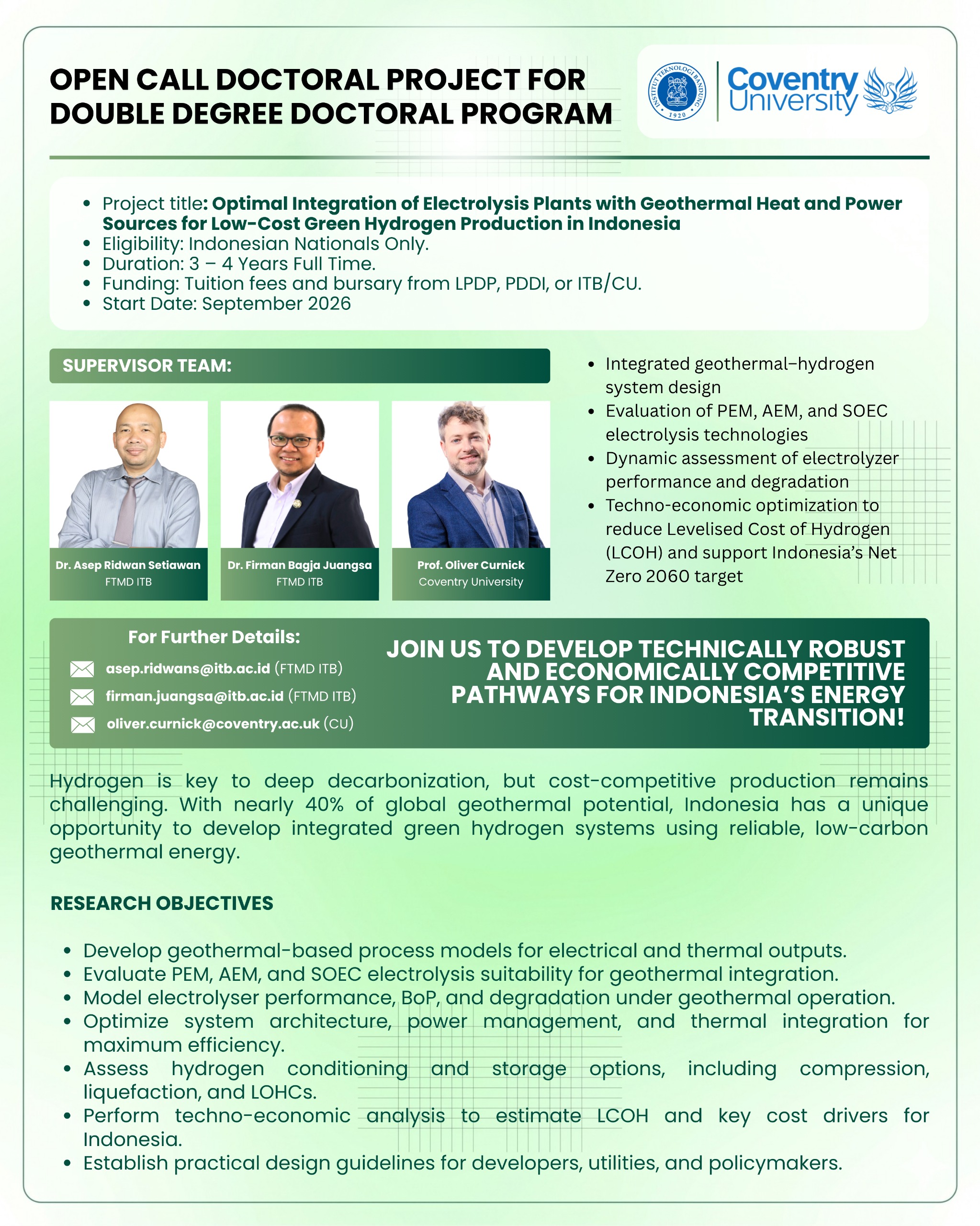
Project title: Optimal integration of electrolysis plants with geothermal heat and power sources for low-cost green hydrogen production in Indonesia
Eligibility: Indonesian nationals
Duration: Full-Time – between three and four years fixed term
Application deadline: 24 April 2026
Interview date: Will be confirmed to shortlisted candidates
Start date: September 2026
For further details contact: Dr. Asep Ridwan Setiawan (asep.ridwans@itb.ac.id) and Prof. Oliver Curnick (oliver.curnick@coventry.ac.uk)
Introduction
Hydrogen is expected to play a central role in the deep decarbonisation of energy systems, industrial processes, and chemical supply chains, provided it can be produced, stored, and distributed with low environmental impact and at competitive cost. At present, global hydrogen production exceeds 100 Mt yr⁻¹, primarily serving petroleum refining and ammonia synthesis, yet the overwhelming majority is derived from fossil fuels, contributing approximately 2.5–3 % of global CO₂‑equivalent emissions. Transitioning this existing demand, while enabling new hydrogen‑based value chains, represents both a major technical challenge and a strategic opportunity.
Water electrolysis powered by renewable electricity offers a scalable route to low‑carbon hydrogen production. However, achieving cost‑competitive hydrogen requires not only advances in electrolyser technology, but also careful system‑level integration with primary energy sources, optimisation of operating strategies, and effective utilisation of heat and power across the plant. Geothermal energy is uniquely well suited to this challenge, offering high availability, low variability, and access to thermal energy across a wide temperature range.
Indonesia possesses approximately 40 % of global geothermal potential, yet this resource remains under‑utilised beyond conventional electricity generation. As Indonesia accelerates geothermal deployment in support of its net‑zero 2060 ambition, there exists a timely opportunity to design integrated geothermal–hydrogen systems that are optimised from first principles, rather than retrofitted onto existing infrastructure. In particular, the combination of geothermal electricity and heat with advanced electrolysis technologies offers the potential to reduce hydrogen production costs, improve efficiency, and enable new export‑oriented green value chains such as ammonia, synthetic fuels, and low‑carbon materials.
This joint ITB–Coventry University PhD project addresses this opportunity by developing rigorous, quantitative models of geothermal‑powered hydrogen production systems, with the aim of identifying technically robust and economically competitive pathways for large‑scale deployment in Indonesia.
Project details
The proposed research will investigate the optimal integration of water electrolysis plants with geothermal energy systems for low‑cost, low‑carbon hydrogen production. The project will adopt a model‑based, systems engineering approach, combining thermodynamic, electrochemical, and techno‑economic analysis to evaluate integrated plant architectures and operating strategies.
A central technical contribution of the project will be the development of physics‑informed process models that capture the interactions between geothermal resource characteristics, power generation systems, electrolyser performance, and balance‑of‑plant components. Particular attention will be given to the utilisation of geothermal heat and electricity across different electrolysis technologies, including proton exchange membrane (PEM), anion exchange membrane (AEM), and solid oxide electrolysis (SOEC), each of which presents distinct opportunities and constraints when coupled to geothermal energy sources.
The research will go beyond steady‑state efficiency analysis by explicitly considering dynamic operation, thermal integration, and electrolyser degradation and lifetime effects under geothermal‑driven operating profiles. These factors are critical for realistic assessment of performance, cost, and reliability, yet remain insufficiently addressed in existing literature. System‑level optimisation will be employed to identify design and operating regimes that minimise the levelised cost of hydrogen (LCOH) while respecting technical and operational constraints.
In addition to hydrogen production, the project will examine downstream integration options for hydrogen storage and conditioning, including geothermal‑powered, compression, liquefaction, and alternative carrier concepts such as liquid organic hydrogen carriers (LOHCs), where appropriate. This will enable assessment of complete production‑to‑export pathways rather than isolated plant components.
The project will culminate in a rigorous techno‑economic and sensitivity analysis, quantifying key cost drivers, performance thresholds, and deployment conditions for geothermal‑powered hydrogen production in Indonesia. The resulting models and insights are expected to provide actionable design guidance and cost benchmarks for project developers, utilities, and policymakers, supporting early‑stage investment decisions and helping position Indonesia as a competitive producer of green hydrogen and hydrogen‑derived commodities.
Possible research objectives include:
- Develop a validated, generic process model of geothermal power systems, capturing electrical and thermal outputs, operating constraints, and resource‑dependent performance characteristics relevant to hydrogen production applications.
- Quantitatively evaluate the suitability of different water electrolysis technologies (including PEM, AEM, and SOEC) for integration with geothermal energy sources, considering efficiency, operating temperature, dynamic behaviour, and technology readiness.
- Develop detailed electrolyser system models that incorporate electrochemical performance, balance‑of‑plant requirements, and degradation and lifetime effects under geothermal‑driven operating profiles.
- Investigate and optimise integrated geothermal–electrolysis system architectures, including power management and thermal integration strategies, to maximise system efficiency and operational robustness.
- Assess downstream hydrogen conditioning and storage options, such as geothermal‑powered compression, liquefaction, and alternative carrier concepts, where relevant, as part of end‑to‑end production pathways.
- Perform a rigorous techno‑economic and sensitivity analysis to quantify the levelised cost of hydrogen (LCOH), identify dominant cost and performance drivers, and evaluate deployment thresholds for Indonesia‑specific scenarios.
- Derive actionable design guidelines and cost benchmarks to support early‑stage decision‑making by project developers, utilities, and policymakers engaged in geothermal‑powered hydrogen deployment.
Funding
Tuition fees and bursary from LPDP, PDDI or potentially ITB/CU
Benefits
The successful candidate will receive comprehensive research training including technical, personal, and professional skills. All researchers at Coventry University (from PhD to Professor) are part of the Doctoral and Researcher College, which provides support with high-quality training and career development activities.
Entry requirements
- A minimum of a 2:1 first degree in a relevant discipline/subject area with a minimum 60% mark in the project element or equivalent with a minimum 60% overall module average.
PLUS
- The potential to engage in innovative research and to complete the PhD within 3.5 years.
- A minimum of English language proficiency (IELTS academic overall minimum score of 5 with a minimum of 6.0 in each component).
Additional Requirements
Applicants should hold a good undergraduate or master’s degree in Chemical/Mechanical/Electrical Engineering, Chemistry, Physics, or a related discipline. Relevant background may include:
- Chemical process/plant modelling
- Programming experience (e.g. Python, MATLAB, C++)
- Electrochemistry
- Thermodynamics
- Technoeconomic analysis
The ideal candidate will be motivated, technically-inclined, and interested in renewable energy technologies and decarbonisation.