FTMD ITB Students Develop Modular Electric Vehicle “Kizuna,” Winning 3rd Place at PLN ICE 2026
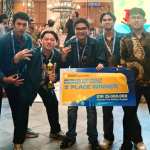
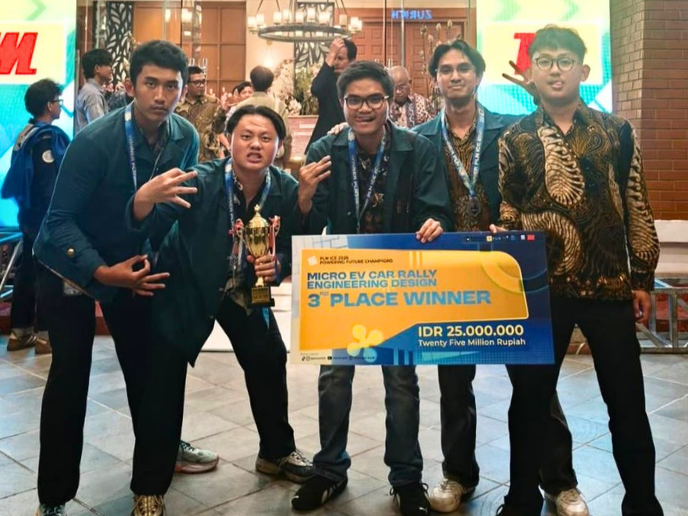
SURABAYA, ftmd.itb.ac.id – Five students from the Faculty of Mechanical and Aerospace Engineering (FTMD) Institut Teknologi Bandung (ITB) won Third Place Nationally in the Engineering Design category of the Micro EV Car competition at the PLN Innovation & Competition in Electricity (PLN ICE) 2026. The achievement was earned through the development of Kizuna, a modular micro electric vehicle capable of transforming from a sedan into a pickup truck by detaching its rear section.
Competing under the team name MotoAMP, the group comprises team leader Jean Matthew Setiabekti alongside Muhammad Nafi Prasetya, Evandyo Anwar, Muhammad Randy Pratama, and Atilla Syahreza Aryaputra. The members hail from two undergraduate programs at FTMD ITB: Aerospace Engineering and Mechanical Engineering. The final round of the competition took place on November 6–8, 2026, at the Institut Teknologi Sepuluh Nopember (ITS) Circuit in Surabaya.
Kizuna: One Vehicle for Multiple Needs
The idea behind Kizuna emerged from the team’s observation of urban mobility demands. Vehicles are not merely used for daily commuting; they are frequently needed to transport cargo or support small business operations. Addressing this dual need, the team developed a modular vehicle concept that adapts its functionality to suit user requirements.
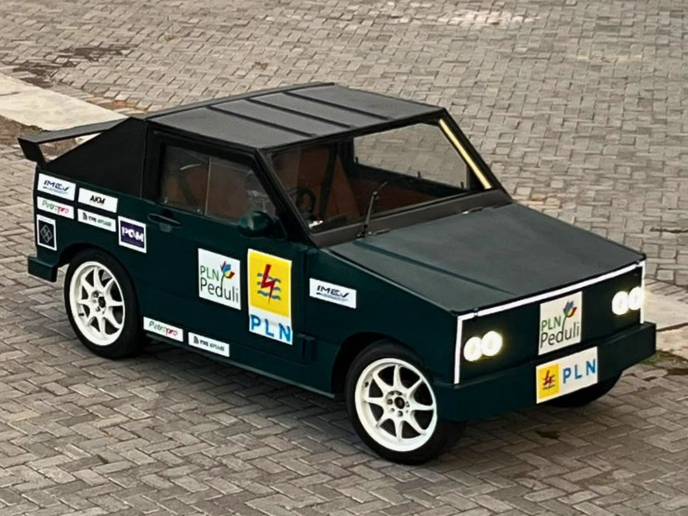
Through this modular system, Kizuna‘s rear section can be detached and reattached, allowing the vehicle to operate in either a sedan or pickup configuration. This design enables a single vehicle to support diverse daily activities without requiring owners to purchase two separate vehicles for different functions.
Jean Matthew Setiabekti explained that the modular system serves as Kizuna‘s primary differentiator compared to other entries in the competition. This architecture was integrated from the earliest stages of development—spanning body dimensions, chassis construction, and the strategic placement of the battery and electrical systems.
Collaborative Engineering Across Mechanical and Aerospace Disciplines
The development of Kizuna leveraged each member’s specialized engineering background. Aerospace Engineering students Jean Matthew Setiabekti, Muhammad Nafi Prasetya, and Evandyo Anwar took on distinct leadership and technical duties: Jean served as team leader, Nafi managed the electrical systems while serving as the primary driver, and Evandyo oversaw mechanical design. Meanwhile, Mechanical Engineering students Muhammad Randy Pratama handled mechanical systems while serving as co-pilot, and Atilla Syahreza Aryaputra took charge of electrical engineering.
Throughout development, the team also received mentorship from Dr. Bismo Jelantik Joyodiharjo, S.Sn., M.Ds., a lecturer from ITB’s Faculty of Art and Design (FSRD). He provided design feedback from the initial module conception stage, assisted with administrative requirements, and continued mentoring the team post-competition so Kizuna can be further exhibited and refined.
During the engineering design process, the team utilized SolidWorks for 3D modeling, alongside Abaqus and SimScale for structural simulations. The vehicle chassis also underwent iterative refinements—evolving from a space frame concept to a semi-monocoque structure—to achieve the optimal balance between structural strength and lightweight performance.
Kizuna is powered by an electric motor with a nominal output of approximately 3 kW and a peak output of 6.6 kW, paired with a 70 V, 150 Ah battery pack. In terms of manufacturing localization, the vehicle achieved a Domestic Component Level (Tingkat Komponen Dalam Negeri/TKDN) of approximately 60–62 percent. Safety features were equally prioritized through the integration of a front crumple zone to absorb impact energy, a fire-resistant firewall isolating the battery compartment, four-wheel disc brakes, and a Battery Management System (BMS) for real-time battery monitoring.
Performance Testing and Future Development
Prior to the competition, Kizuna underwent performance trials around the Gelora Bandung Lautan Api (GBLA) area in Bandung. Test results demonstrated that the vehicle accelerates from 0 to 50 km/h in under nine seconds and reaches a top speed of approximately 65–70 km/h.
Based on battery capacity calculations, Kizuna has an estimated range of around 100 kilometers on a single charge. During a 20-kilometer road test in Surabaya, the battery indicator dropped by only about 12 percent.
Looking ahead, the team plans to refine several technical aspects of the vehicle, including its suspension system, turning radius, and electrical component cooling. Kizuna‘s modular platform also opens opportunities for interchangeable rear modules featuring different forms and functions, such as wagon, touring, liftback, and cabriolet variants.
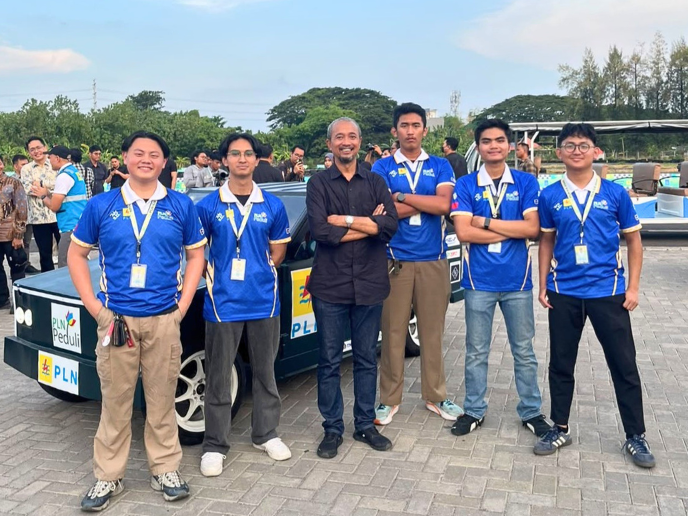
Team MotoAMP’s accomplishment at PLN ICE 2026 showcases the ability of FTMD ITB students to integrate Mechanical and Aerospace Engineering principles into practical engineering solutions, further enriched by interdisciplinary collaboration with FSRD ITB.
Through Kizuna, the students not only built a functional electric vehicle, but also pioneered an adaptive design concept tailored to real-world mobility needs. This milestone is expected to inspire FTMD ITB students to keep developing bold ideas, leverage cross-disciplinary expertise, and deliver impactful innovations for industry and society.
#SDG4 #SDG7 #SDG9 #SDG11